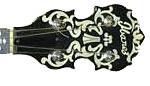
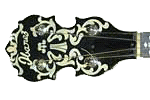
The American banjo originated in skin-headed instruments brought by slaves from Africa. Gradually, the instruments started to approach the appearance of the banjos of today. During the early years of the 20th century, the banjo became immensly popular and many new instrument manufacturers, each with their own variations of the instrument emerged. Most of the manufacturers went out of existance during the crash of the 30s. Gibson is one of the few survivors. Currently, Ome, Richelieu, and Gibson build 4-string banjos.
The members of the Austin Banjo Club play several very different varieties of banjo.
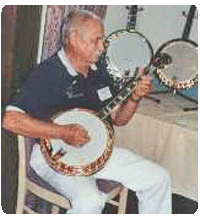
The Plectrum Banjo
The plectrum banjo is essentially the 5-string Bluegrass banjo without the short 5th (drone) string. The plectrum banjo is named for the "plectrum" or flat pick that is used in playing our style of music.
Plectrum banjos are played in several different styles: rhythm strum, and chord melody. The majority of players in our band play rhythm; the melodic strumming that forms the background for the melody. Some of our more advanced players play chord melody; a series of multi-string chords where the top note of the chord forms the melody line.
The plectrum banjo is tuned CGBD
The Tenor Banjo
The tenor banjo has a shorter neck than the plectrum banjo. The tenor banjo is principally used as a melody instrument although some advanced players play chord melody. The tenor banjo was developed early in the 19th century when many violin and viola players moved over to the, then wildly popular, banjo.
The tenor banjo is tuned CGDA. The interval between adjacent strings is a musical fifth; this regularity is valuable in a melody instrument.
Notable builders of tenor banjos are Vega, Bacon & Day, and Gibson. Of these, only Gibson has survived to the present.
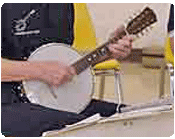
The Mandolin Banjo
The mandolin banjo is an 8-stringed instrument, roughly the size of a violin and is voiced a musical fifth above the tenor banjo. The strings are tuuned in pairs.
Like the tenor banjo, the mandolin banjo was developed in the early 19th century when violin and viola players moved over to the, then wildly popular, banjo.
The mandolin banjo is tuned GDAE.
The Five-String Banjo
The 5-string banjo is not ordinarily found in a banjo band, but ABC has several 5-string players. The short 5-th string, or drone string, is ignored when playing in a 4-string band. There are a number of different tunings used by 5-string players. The 5-string banjo is normally played without a pick.
Other Banjos
Occasionally, as players come and go, the band may include unusual banjos such as the six-string (guitar) banjo which was developed so that guitar players can switch back and forth easily. Another instrument that sometimes joins us is the ukelele banjo.
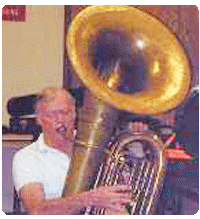
Tuba
Traditional banjo bands use a tuba as the principal rhythm instrument; the melodic equivalent of a bass drum. Our band is no exception and we have several tuba players who play with us. The tuba is especially valuable when we play outdoors or play in a place with poor accoustics.